.png?width=375&height=100&name=WebPage%20logo%20with%20curves%202026%20(8).png)
Where I live, there aren't too many days when the winter air gets chilly, but every once in a while... brrr! ❄️Walking the dog is a little different when the temperatures dip below freezing. Those are some quick trips; neither of us wants to spend too much time outside!
Sometimes I'm amazed at how humans use tools and technology to survive in areas where we should be people popsicles. What's even more amazing, though, is how animals survive bitter cold without tools or tech!
How do they do it? There are so many options! Scientists have been studying small, non-hibernating mammals like shrews, common weasels, and stoats to see how they survive. The answer? They shrink their brains! 🧠 To survive when the food starts to run out, these little brains can get up to 30% smaller. The smaller brains require less energy to keep running, so the animals need less food. Amazingly, the brains increase back to normal when spring arrives.
 By Ontley - Own work, CC BY-SA 3.0, https://commons.wikimedia.org/w/index.php?curid=5728964
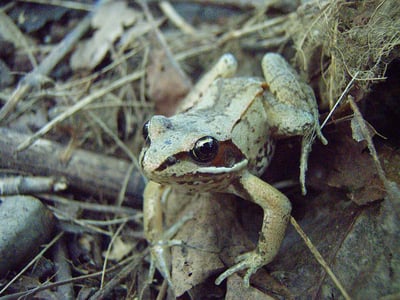
Wood frogs are another fascinating winter survivor. Most frogs burrow down into the mud in the bottom of lakes and ponds and hibernate under the insulating material. Wood frogs, though, are a little different. They survive some of the harshest winters in the U.S. and Canada by becoming frog-sicles! When the temperatures get below freezing, their bodies mostly turn to ice. Their hearts stop, their brains stop; they are as close to dead as an organism can get for weeks at a time!
Normally, freezing destroys cells, and having no circulation or brain activity would mean the frog... croaks. 😆 Not wood frogs! First, their bodies pump their cells full of extra glucose, a natural anti-freeze. Then they increase the blood in and around vital organs like their hearts. When the rest of the frog freezes, the glucose keeps the cells and organs unfrozen and ready to re-animate in the spring!
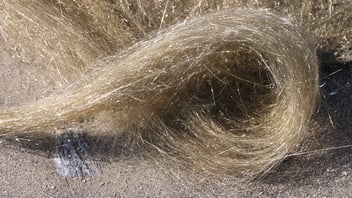
What about larger creatures? Deer decrease their metabolism by reducing movement and slowing down their heart rates. Arctic foxes grow thicker tufts of fur like snow boots on the bottoms of their feet, protecting against the cold and improving traction. Some birds migrate out of cold weather, but those who stay put fluff up their feathers to create insulating pockets of air.
For warm-blooded animals like deer, weasels, birds, and foxes, the main challenge of winter is keeping up enough energy when food is scarce. The responses that help animals survive extreme temperatures (shivering, sweating, etc.) all require energy to happen. Even small changes in temperature can have a big effect on how efficiently their bodies function. Here's a graph of how mice respond to changes in temperature:
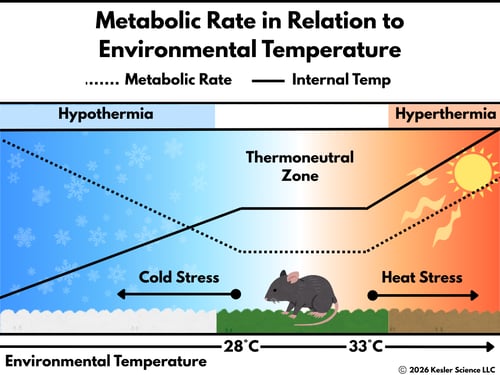
Here are some questions this graph could answer:
💡The "thermoneutral zone" (TNZ) is the ideal temperature for a mouse. Between what ambient temperatures is the mouse TNZ? What do you notice about the metabolic rate (energy being used by the mouse) in this range?
💡Describe what is happening to the environmental temperature and mouse metabolism if you start at the TNZ and move left.
💡Hyperthermia and hypothermia are dangerous health conditions. The prefix "hyper-" means over, and the prefix "hypo-" means under. Based on these definitions and the information in the graph, describe what it means for a mouse to have hyperthermia.