.png?width=375&height=100&name=WebPage%20logo%20with%20curves%202026%20(8).png)
In the 1960's, people living in the Yokkaichi area of Japan began to have strange symptoms. They were developing asthma, bronchitis, and other respiratory problems at a rate far higher than their neighboring towns. The most likely problem? A huge, old factory was missing the equipment needed to clean its waste products. The factory was pumping sulfur dioxide and sulfuric acid into air, and to make it worse, most of the trees in the area had been cut down to make room for construction!
The government of Japan created new laws to force factories like the one in Yokkaichi to clean up. At the same time, people began to look for ways to replace the forests that had been lost. They hoped that creating natural spaces around factories would improve the air quality because plants absorb many toxic gases and trap other pollutants in the air.
There was a problem, though. It takes a LOT of plant life to make a difference in air quality. You can’t just plant a few trees along the road. You also can’t plant a bunch of random seeds and hope they grow into a forest 50 years later. You need a plan!
In 1971, the country’s largest steel maker hired Dr. Akira Miyawaki, a botanist, to design areas around their factories that would grow quickly into natural, miniature forests. What Dr. Miyawaki designed was completely different than anything tried before.
His instructions went like this. First, spend months preparing the soil with mulch and compost so it is full of nutrients. Next, plant small saplings of native trees and shrubs very close together. This encourages competition for sunlight so the trees focus on growing upward. Finally, spend two years weeding the forest to remove unwanted plants that might interrupt the saplings’ growth.
Did it work? Yes! The tiny sites, some just the size of two tennis courts, began to grow into dense forests. Unlike typical tree planting projects with one type of tree, these had a canopy of tall trees, a range of shorter trees, and lush shrub undergrowth. In just 30 years, they looked like forests that had been around for 100 years. The steel company that started it all now has over 2,000 acres of Miyawaki forests all over their factory locations, and other cities around the world are adapting the idea to their local climate and conditions.
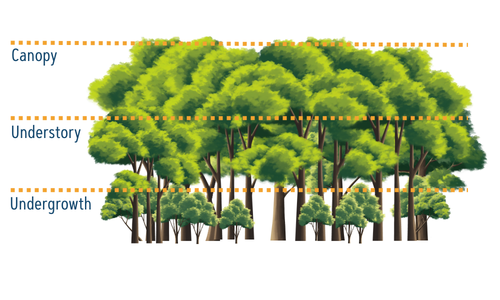 The dense little "pocket" forests have tons of ecological benefits. They prevent soil erosion, cycle nutrients in the ground, capture atmospheric pollutants, and help lower temperatures in heavily-paved areas. The forest patches are like an oasis to small local wildlife too! Birds and insects flock to Miyawaki forests as a nesting site and food source. 🐛
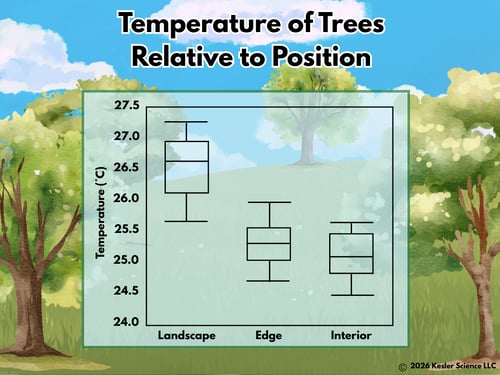
The boxplot graph (aka box-and-whisker graph) below shows the difference in temperature between isolated trees grown in the landscape of a paved environment, trees living on the edge of a pocket forest, and trees living deeper in the interior of a pocket forest. All the temperature data was taken at the canopy level. Take a look:
Here are some questions we can discuss with this graph:
💡What is the dependent variable in this graph? What is it dependent on?
💡The center line within the boxes shows the average temperature recorded for that specific tree location. How do the average temperatures of pocket forest locations compare to the temperature outside of the forest?
💡The lines with flat tops and bottoms that extend out of the boxes are called "whiskers." They show the highest and lowest temperatures for each tree location. Which location has the greatest range of temperatures? What is that range of temperatures?
.png?width=352&name=Sand%20Composition%20Graph(2).png)