.png?width=375&height=100&name=WebPage%20logo%20with%20curves%202026%20(8).png)
Fire is great in a barbecue pit, but there are some places where you never want to see a flame. An airplane, for example, is a terrible place to put out a fire. There isn't much space to maneuver, and some parts are full of electronics that do NOT appreciate water. Using spray foam is an option, but that will leave residue that needs to be cleaned up, too.
So how do you put out a fire without a huge mess?
First, let’s think about the anatomy of a fire. Every fire is a chemical reaction. If you start a camp fire, the fuel source is the wood. You need the activation energy in the form of a lit match or a spark. You also need oxygen to keep the reaction going, which is why a fire goes out if you stack the logs too tightly.
A sound-based fire extinguisher works by disrupting the flow of air that feeds a flame. The sound waves vibrate the air around the flame, interrupting the steady flow of oxygen that keeps the fire burning.
You might think the sound level would need to be loud enough to burst eardrums, but scientists disagree. Years ago, the Defense Advanced Research Projects Agency (DARPA) was researching creative ways to put out fires in enclosed spaces like airplanes or ship hulls. They found that low frequency sounds, in the range of 30 to 60 hertz, are best at extinguishing fires, and the volume is less important. Look at the size of the setup!
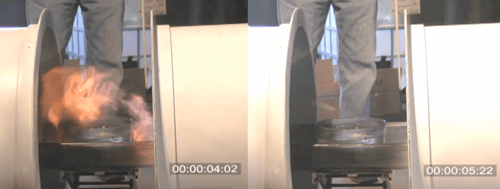
Capture from https://www.youtube.com/watch?v=DanOeC2EpeA
Over the years, people have created sound-based fire suppression systems that took up a lot of space. Recently, though, two engineering students got creative. They took the technology one step further by developing a handheld anti-flame subwoofer. Imagine a speaker with a handle that you can point at a burning fire to put it out. 📢🔥It's surprisingly effective on smaller flames!
Another company is hoping to bring sound-based fire suppression to homeowners. This could be a big deal if you live where risk of wildfire is high. The company founders, who include a former NASA engineer, have designed sleek fire prevention systems that fit below the eaves of the house. The system includes a sound-generating motor and copper pipes with small speakers directed towards the surrounding property.
When a home is near the pathway of a wildfire, embers pose the biggest threat. They can travel long distances and enter attic vents leading to large interior fires. A sound-based system is designed to disrupt embers up to 25 feet away with ultra-low frequency sound waves that are inaudible. Because this prevention method doesn't require water or foam, a person in the house might not even notice the system doing its job!
Why is there so much interest in protecting homes from wildfires? The graph below shows the average number of acres burned by wildfires in the US in a year:
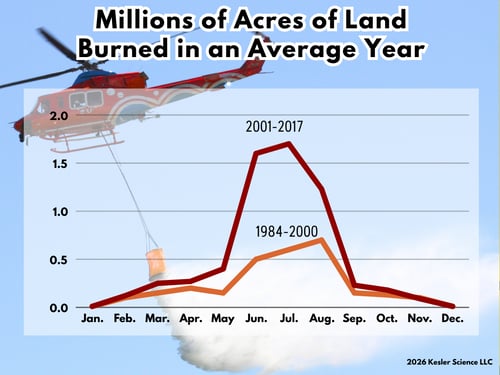
Here are some questions I think of when I look at this graph:
💡What differences do you see in the 1984-2000 data compared to the 2001-2017 data? In the 2001-2017 data, more acres of land have been burned overall, and the peak months are much higher.
💡For each time period, based on the data, which months of the year would have the greatest risk of fire damage to homes? For both sets of data, the acres burned by wildfires reaches a high point between May and September (during the summer months).
💡What months show the least difference between the two time periods? Think of some reasons that might be true. The winter months of November, December, and January are the same in both time periods. They are very low. This could be due to more rainfall, fewer lightning storms, more snow cover, or other factors.