.png?width=375&height=100&name=WebPage%20logo%20with%20curves%202026%20(8).png)
The arachnid family is full of oddball creatures. Scorpions have those venomous stingers on their tails. Spiders can make silk come out of their spinnerets and build elaborate traps with it. Vinegaroons spray acetic acid that smells like vinegar when threatened. But the weirdest member of this remarkable family might be the solifuge.
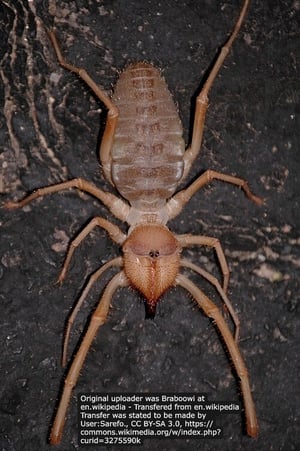
Never heard of it? It's also known as the the camel spider. It may have earned the nickname because they are typically found in arid regions, like Libya, Afghanistan, and southwestern states like Nevada and Utah. They have a "camel-like" endurance in these dry habitats.
Unlike true spiders, the camel spider lacks the spinnerets and silk needed to construct webs. Without spinnerets, solifuges rely entirely on speed and agility to capture prey — and they can MOVE.
Scientists have observed that they can run somewhere between 6 - 10 mph. That means they can cover about 15 feet in a second! It also seems like they never tire out. That's an exaggeration, but a scientist tracking how far solifuges run spent over an hour chasing a specimen before finally giving up. 😅 It's safe to say these are the marathon runners of the Arachnida class.
Solifuges have a legendary appetite, too! They'll aggressively hunt anything they can fit into their oversized mouthparts. Solifuges are only 3 - 6 inches long, including their legs, so most of their diet consists of insects and the occasional small lizard or mammal. If there is food available, the camel spider will go after it. In captivity, some solifuges have been known to gorge themselves to dangerous levels — they simply don’t know when to stop eating.
Solifuges have lots of other super abilities to set them apart as well. They have strange fan-shaped organs below their fourth pair of legs to detect scents and chemical signals in their environment. They have huge mouth parts that resemble crab pincers, helping the solifuge chomp on its prey with brutal efficiency.
Solifuges are harmless to people; they don't have venom, and they are not likely to bite if left alone. They can give a really good pinch with their mouthparts if hassled, though! Sometimes they appear to be chasing people in dry climates, but really, they're only trying to take advantage of the human's enormous shadow.
Here's a weird fact: arachnids have four pairs of legs, but if you saw a solifuge, you'd notice a fifth pair of legs at the front of the organism. These are the pedipalps and they function a lot like sensory antenna you'd find on most insects. On the ends of the pedipalps are suction organs to help latch on to surfaces or grasp their prey. They're like antenna combined with suction cups!
A team of scientists observed the habits of solifuges living in and around Spain. Among other things, they noticed the solifuges' weather preferences. Take a look a the graph below:
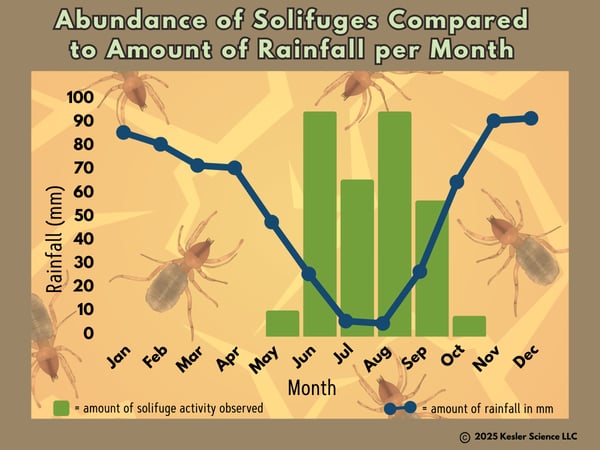
If I brought this graph into the classroom, here are some questions I'd have to go with it:
💡During which months of the year is rainfall the greatest in this location? During which months of the year does the least amount of rain fall in this area? (Include specific measurements)
💡Is there a relationship between rainfall and solifuge abundance based on this graph?
💡What is the difference between the abundance of solifuges in May compared to the abundance of solifuges in June? Predict why this change might occur.
.jpg?width=352&name=640px-Canis_dirus_-_Cleveland_Museum_of_Natural_History_-_2014-12-26_(20859228068).jpg)