.png?width=375&height=100&name=WebPage%20logo%20with%20curves%202026%20(8).png)
Have you ever watched a spider constructing its web? 🕸️ 🕷️ It has to work slowly and carefully to place all the sections of silk. Then, when rain, wind, or large organisms break through, it has to carefully repair or replace the web, over and over again. It's a huge use of the spider's energy, and it limits the size of the web to whatever is practical to maintain. There's no sense in making a 10-foot web if it's always hanging in shreds!
But what if a spider found a spot where its work would be undisturbed? How big could the web get?
On the border of Greece and Albania is a sulfur cave that stays 80°F year-round. The cave smells like rotten eggs, but the hydrogen sulfide inside feeds a steady supply of bacteria. The bacteria create a slimy biofilm that feeds aquatic organisms like worms, snails, and midge larvae. When the midges become adults, they fly around the cave by the millions, creating a fantastic food source for bats and insects.
Inside this cave, scientists found one of the largest spiderweb structures ever documented. The team estimates that the web covers about 100 square meters, which is the footprint of a small house!
Did one very hardworking spider do all this web-spinning? No! Besides being huge, this web is also special because it was built by many spiders - over 100,000 arachnids working very close to each other. 😮 Interestingly, the two spider species that live together on the web typically do not get along! The common house spider (Tegeneria domestica) would normally eat the smaller sheet weaver species (Prinerigone vagans), yet they are basically roommates in the oversized cave web. 🤔
The web is a little different than the classic orb-weaver style you might picture. It clings to the cave wall as a soft, squishy mat of funnel webs. It's perfect for trapping midges, and it makes a great hideout for when the spider homeowners feel threatened by bats and other insect cave dwellers.
Experts have several ideas to explain how these spider enemies became neighbors. One is that the spiders just can't see each other in the pitch-black cave to know that they are different species. Another is that there's so much easy food available in the cave, the larger house spiders lose their drive to hunt harder prey. It's also possible that the spiders learn over time that midge-sized vibrations hitting their funnel are food and all other signals are not.
In addition to their unique behavior, the cave spider species have some special physical characteristics. First, both spider species have slightly different DNA from their relatives that live in the fresh air. They have a few genetic mutations that aren't found in the non-cave dwellers.
Second, the female spiders lay fewer eggs than their fresh-air cousins! Scientists think this may be because spider offspring are more likely to survive in the cave. Spiders that spend less energy on creating eggs have more energy to spend on their own survival. Over time, cave spiders that laid fewer eggs would have outnumbered the spiders that laid more eggs, so that adaptation was passed on to more and more spiders.
Here's a graph breaking down the number of eggs per egg sac of the cave-dwelling T. domestica in three different months:
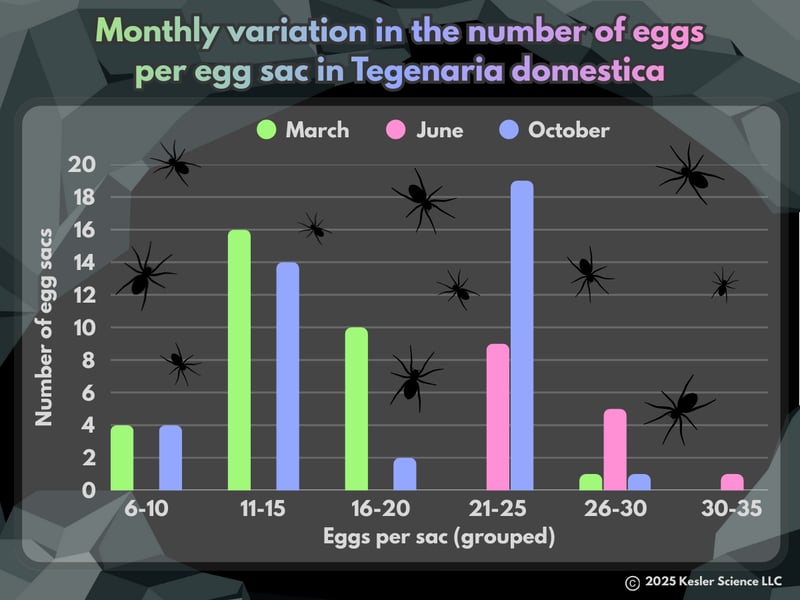
If I brought this graph into the classroom, here are some questions I'd have to go with it:
💡 In March, how many egg sacs had between 6 and 10 eggs inside? How many March egg sacs had 21 - 25 eggs inside?
💡 How many total egg sacs were examined in October? What was the most common number of eggs found in the October egg sacs?
💡 If you were a scientist who wanted to collect egg sacs with the highest number of eggs inside, in which month should you visit the cave? Why?