.png?width=375&height=100&name=WebPage%20logo%20with%20curves%202026%20(8).png)
One of the oldest observatories in the United States is the Lowell Observatory in Flagstaff, Arizona. It was built in 1894! Back then, a man named Percival Lowell was just getting started investigating space. He funded the building of the observatory, then, through its telescopes, he studied the surface of Mars. He got excited when he saw straight lines spread across the planet. He thought these must be signs of intelligent life! Maybe they were canals used to carry water from the icy polar caps to underground cities?
While Lowell's idea of Martian canals was creative, it was not accurate. Once we got a closer look at the dusty red planet in the 60's and 70's, we saw that Lowell's "waterways" were just optical illusions created by craters and other geological formations. There were no signs of ancient alien cities.👽
Fast forward to modern day, and scientists have spotted new formations on Mars. There are mile-long carvings etched into giant sand dunes at Russell Crater. The lines look a little like dried-up river beds, but they appear very fresh. They mysteriously stop in a large pit.
Scientists just tested a theory on how the formations are made in a vacuum chamber designed to mimic the conditions on Mars. Engineers constructed a sandy incline within their Mars chamber and stumbled on a way to recreate the carvings within the sand dunes. The material responsible for those mysterious Martian formations was finally confirmed: dry ice! ❄️
Dry ice, or frozen carbon dioxide, needs very cold temperatures to form: -109 degrees Fahrenheit! On Earth, dry ice never happens naturally. To make it, we compress carbon dioxide gas until it condenses into a liquid. When we release the pressure, the liquid cools rapidly and forms flakes of dry ice.
The atmosphere on Mars is 95% carbon dioxide and has an air pressure that is less than 1% of Earth's. In that kind of environment, weird things happen. On Mars, conditions get cold enough to freeze carbon dioxide out of the air naturally. 🥶
Scientists think beds of dry ice form on sand dunes during the Martian winter. They suspect that when the temperatures start to warm a little, blocks of ice break off. Instead of melting, the dry ice starts sublimating, or turning directly from ice to gas, creating a cushion of carbon dioxide gas between the solid ice and the ground. The blocks would slide like a puck on an air hockey table! All it would need is the right angle to start sliding.
Scientists discovered in their test chamber that the process works, but the angle has to be just right to create the bizarre sand formations. Less than approximately 22 degrees is perfect. At that angle, the sliding dry ice digs into the sand as it slides. The sublimating block kicks out the sand as it converts to carbon dioxide, leaving a carved sand dune trail in its wake. Once the ice block reaches the bottom, it finishes sublimating into the atmosphere again - leaving nothing behind!
One way scientists are supporting their icy theory is by looking for CO2 ice by studying the light that reflects off the surface of Russell Crater. Scientists can measure the wavelengths of the light to see what substances the light is reflecting from. Check out this graph:
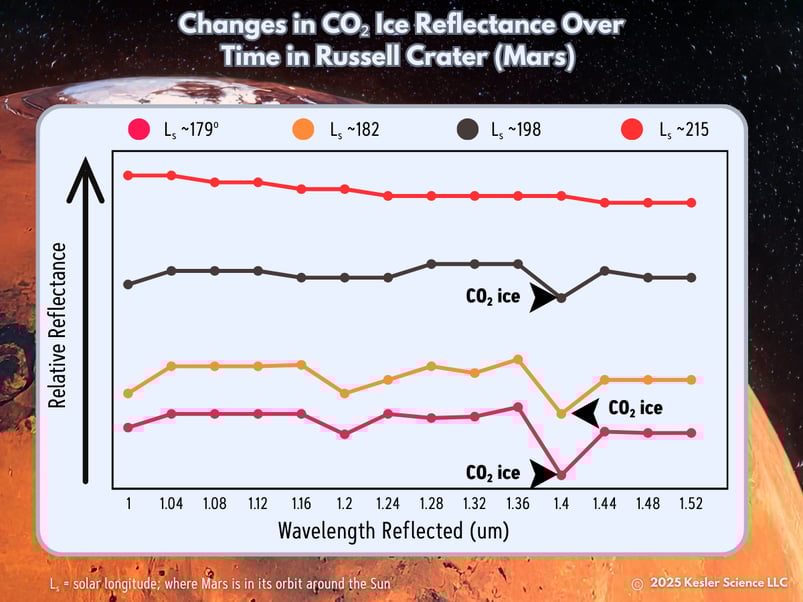
If I brought this graph into the classroom, here are some questions I'd have to go with it:
💡The meaning of LS is the angle at which sunlight is hitting the surface. The angle of light changes through the year. The ~ symbol means "approximately". LS ~144° is the angle of light at mid-winter, and LS ~221° is the angle of light at mid-spring. What time of the year is represented by the angles in the graph?
💡Scientists can use reflected light to identify substances. When light reflects off a material, the reflected light shows dips at certain wavelengths because the material absorbs that wavelength of light rather than reflecting it. What is the wavelength that dips when reflecting off frozen carbon dioxide (CO2)?
💡Based on the data from the graph, what is happening to the CO2 ice as the season changes from winter to spring? How can you tell?
.png?width=352&name=Ocean%20Zones%20(5%20x%2010%20in).png)