don't have long hair, but somehow, it's usually my job to clean the hair gunk out of our shower drains. What comes out is NOT a pretty sight. 😱
Just because I find leftover hair disgusting doesn't mean everyone does, though! Or at least, not everyone feels like just throwing hair away. A creative team of entrepreneurs in San Francisco sees human hair as a resource. They're hoping to find a better use for the estimated millions of pounds of human hair that end up in the landfill each year.
Hair happens to have some very useful properties that are often overlooked. For one, it's amazing at soaking up oil. Why? First, it has a huge surface area. If you have one kilogram of hair, that hair has a combined surface area of about 250 meters squared! Plus, all of that surface is covered in tiny scales called cuticle. The scales resist water but hold on to oil. In fact, hair can hold up to five times its weight in oil! Scientists call this property "adsorbency" (instead of "absorbency").
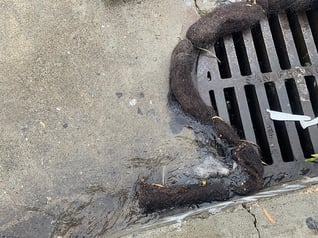
The eco-friendly business in San Francisco creates woven mats from donated human hair waste. The mats are being used to sop up oil leaks in garages and roadways. Some of them are placed around storm drains. By filtering storm water before it runs into drains, like in the picture above, the mats keep oils from getting into rivers and lakes downstream.
Long tubes stuffed with hair can collect oil spilled by ocean tankers as well. Tankers spill over 350,000 tons of oil in a year, so finding a solution is important. In one case, a tanker ran aground and spilled over 1,000 tons of oil in the waters off Mauritius, a small, beautiful island nation. People from all over the country banded together to save their shoreline. They created booms, or large tubes that float, to adsorb the oil. They included human hair as filler in their booms. Their neighboring country, Australia, collected and sent over 28,000 tons of hair for their goal! People worked together to stuff hundreds of feet of hair booms per hour. The hair booms were so effective that they cleaned 75% of the oil out of the water!
It turns out that hair is a fantastic "green" alternative to using plastic-based materials to soak up oil spills. Hair is naturally biodegradable, breaking down within 18 months. It's a natural fertilizer, too, because it's full of nitrogen. One study found that if hair can come in contact with oil for 30 minutes, it can adsorb 99% of that oil! It can also be washed with NaOH to clean it, which brings it back to 80% of its original adsorbency. This is far more efficient than plastic-based methods.
Hair is also abundant. Besides lurking in shower drains, stray hair can be found in many places. Salons around the world create a combined total of 900,000 lbs. of daily hair waste!
The following graph shows how different substances performed when tested for adsorbency. Not every material was tested against every kind of oil. Check it out:
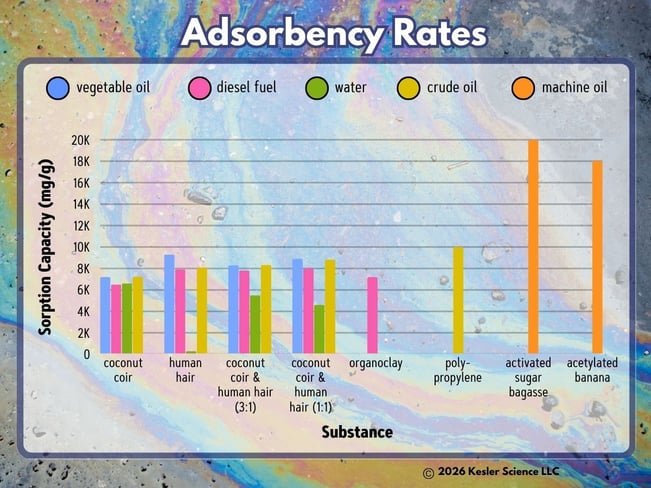
Here are some questions I'd have looking at this graph:
💡According to the graph, which material tested has the least amount of adsorption for vegetable oil? Which material has the greatest adsorption of vegetable oil? Using data numbers to the nearest thousand, what percentage is the greatest amount adsorbed higher than the least amount adsorbed?
💡Look at the results for coconut coir and human hair, including the blends of the two. 3:1 means three parts of coir to one part of hair; 1:1 means equal parts. How does blending the two affect the adsorption of crude oil?
💡Look at acetylated banana and activated sugar bagasse. Based on the graph, can we assume that combining the two substances would create a much better substance to adsorb machine oil?