.png?width=375&height=100&name=WebPage%20logo%20with%20curves%202026%20(8).png)
In nature, many organisms send a clear signal with their coloring that says, "Don't mess with me." Bright colors and bold stripes are warning of future pain from stings, venom, or really nasty smells. 🐝 But the giant honeybee of Southeast Asia, Apis dorsata, uses a totally different strategy to deter intruders. These bees gather on their giant comb and shimmer. ✨
How do bees shimmer? When bees on the outside of their comb sense danger, individuals will flip to show their abdomen, revealing a darker color. The flipping isn't something random individuals do, though. The bees work together to flip in ways that create patterns like pulsating waves and hypnotic spirals.
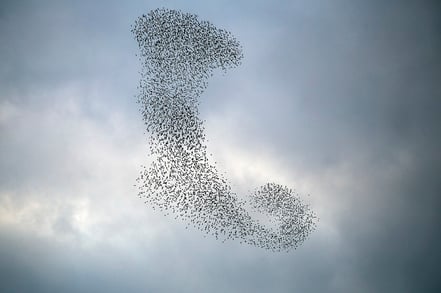
Examples of incredible collective behavior happen all over in nature. Huge schools of fish twist and turn together like shiny clouds in the ocean water. Herd animals on the African plains quickly respond to changes in their environment to stay together as they shift directions. European starlings gather in enormous flocks called "murmurations" that look like black dust swirling in the sky.
Some of these organisms aren't very unimpressive on their own, like a plain black bird or one shiny little fish. How do they put on these dazzling displays when they get together? Is it some kind of animal telepathy? 🤔
Scientists call this behavior "scale-free correlation." They're talking about scale as in measuring size, not the scales of fish or snakes. Scale-free means that, no matter how large the group, a change made by just a few individuals can spread across the whole collection. A few birds changing direction will cause the whole flock to spin away. A few fish diving deeper will take the whole school in the same direction. The changes started by a few are transferred to the crowd.
One trait all these creatures share: members of the group are happy to change their behavior based on what they see other members doing. In one experiment, scientists noticed that large groups of damselfish will instantly hide in coral at the first sign of danger. When they analyzed camera footage, the scientists noted that only some individuals actually saw the danger. When they hid, their neighbors saw the reaction and took the same action. Then the fish next to those fish took the same action, and so on. This immediate reaction to others' behavior spreads information rapidly through the whole group!
Another trait the members of a hypnotic swarm usually have is really fast reaction times. They are able to change their behavior and take action far faster than a human could. This ability to turn on a dime or make a split-second decision is critical to matching the behavior of the group. Without this trait, shimmering bees would be more of a slow wave, which sounds relaxing instead of threatening!
Why do large groups demonstrate this kind of behavior? Scientists think one reason is to disorient potential predators. Starlings will often create murmurations before settling down for the night, which confuses hawks hunting for isolated individuals. The giant honeybees shimmer to distract threatening wasps, who are unable to focus on one individual to attack. While the bees will start stinging if necessary, shimmering is also much safer.
Citizen scientists once collected data about the duration of starling murmurations and the amount of daylight. Here is a graph of their findings:
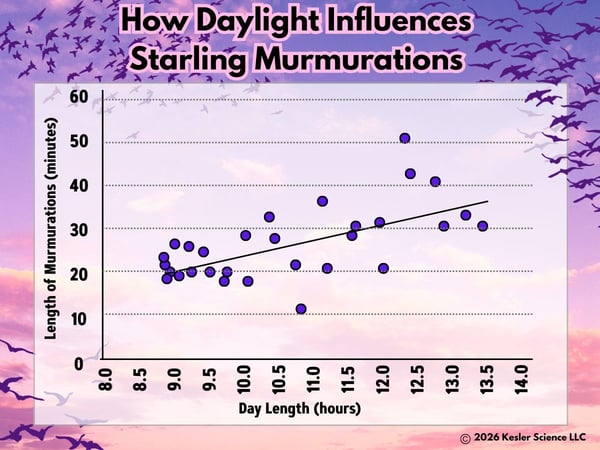
These are the questions I think of when I look at this graph:
💡What is the length of the longest murmuration on this graph? How many hours of daylight were there when this occurred?
💡What relationship do you notice between the length of a starling murmuration and the amount of daylight in a day?
💡Some scientists think starlings use murmurations to generate heat to keep the birds warm. Does this graph offer any data to support that idea? Explain.