.png?width=375&height=100&name=WebPage%20logo%20with%20curves%202026%20(8).png)
Two big names in history, separated by hundreds of years: Leonardo da Vinci and Nikola Tesla. According to popular stories, what did they have in common? Naps! Supposedly, both preferred taking short naps throughout the day instead of sleeping through the night.
It's a fun coincidence if true, but scientists say humans usually need seven to nine hours of sleep for good brain and body health. Short sleep isn't the productivity hack it sounds like.
But what about animals?
Almost all animals, from huge to tiny, show some form of sleep. And by "sleep," we're talking about an easily reversible state of inactivity that happens every 24 hours. But do animals sleep the same way? Not at all!
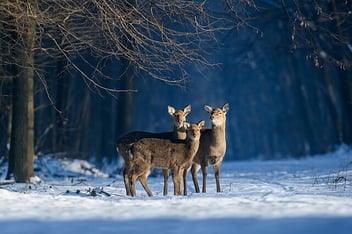
Let's start with when different creatures sleep. Some animals are diurnal (active during the day), while others are nocturnal (active at night). A third group, called crepuscular animals, are most active at dawn and dusk. Deer and house cats fall under this category of sleepers. 🐈
In the animal kingdom, the length of a sleep session can be even more varied than when different species sleep. One rule of thumb is that prey animals tend to sleep less than predators. Male lions can afford to snooze for 20 hours a day because there are few threats while they are vulnerable. Giraffes, on the other hand, sleep in short 5-minute intervals - many times with their eyes still open! 👀 It is believed that in the wild, giraffes can survive on a combined total of 2-3 hours of sleep per day.
Big, herbivorous animals may also need to sacrifice sleep just to get in enough calories in the day. Cows only get about 4 hours of sleep a day, as they spend most of their time chewing on low nutrient grasses. Elephants have huge nutritional demands and may spend less time sleeping than any other mammal. They'll only get about 2 hours of sleep in the wild distributed across naps. They're the Da Vincis of the African savannah 😆.
Speaking of power naps, the chinstrap penguin gets a respectable 11 hours of sleep in a day, but penguin parents will distribute this sleep over thousands of micronaps while watching their eggs! Scientists think this helps the penguin meet their sleep needs while keeping an eye out for predators.
If we wanted to find the animal that gets the most shut eye over the course of a day, we'd have to travel to the land down under. Koalas log a whopping 22 hours of sleep in a day, snuggled up in eucalyptus tree crevices. 🐨 Why do the koalas sleep so much? Aren't they herbivores who need to load up on the calories?
Koalas have an extremely specific diet of certain types of eucalyptus leaves. It is believed this diet may lead to drowsy koalas, as their bodies need a long time to digest the tough, fibrous leaf matter. There are also certain chemicals within the leaves that take a long time for the koalas to break down. (The toxins themselves are not the cause of koala sleepiness, contradicting a popular explanation). Since koalas are tucked away up in the trees, the marsupials won't be bothered by other animals while they nap! 💤
Here is a graph of the sleep periods of different animals observed in captivity:
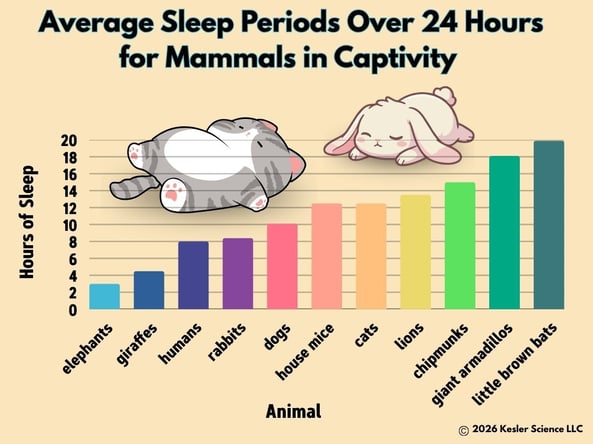
If I brought this graph into the classroom, here are some questions I'd have to go with it:
💡In the wild, giraffes only sleep between 2-3 hours in a day. How does this compare to the sleep data for giraffes in captivity? How do you explain this difference?
💡A pet owner has a dog, cat and rabbit. Which animal sleeps about the same amount in 24 hours as a human?
💡How does the sleep data of the little brown bat compare to rodents of a similar size, like mice or chipmunks? Why do you think this pattern exists?