.png?width=375&height=100&name=WebPage%20logo%20with%20curves%202026%20(8).png)
If I gave you 30 seconds to draw a flower, I bet I could guess how your picture would turn out. Quick: a green stem, two leaves stuck on the stem, and a flower at the top, probably with five round petals. How did I do?
We picture flowers this way because so many plants follow this blueprint to meet their needs. Stems transport nutrients from the roots, leaves perform photosynthesis for food, and flowers attract pollinators so the plant can reproduce. It’s a classic look for a reason!
Every once in a while, though, there’s an oddball plant that throws the usual pattern right in out the window. One of those is Balanophora fungosa, a native of tropical forests in East Asia. 🍄
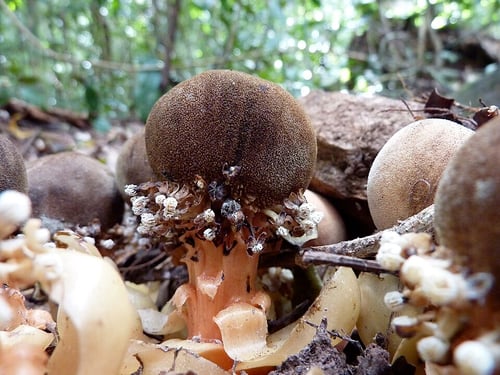 By Geoffrey Derrin - Own work, CC BY-SA 4.0, https://commons.wikimedia.org/w/index.php?curid=37662864
If you think the Balanophora plant looks like a mushroom, you’re not alone. Scientists even included “fungus” in this plant’s name. Mushrooms are part of a completely different kingdom, though, and don’t have the same structures that plants have. Balanophora is a plant cosplaying as a fungus! For example, the top that looks like a puff ball mushroom covered in spores? It’s actually a dome covered in some of the world's smallest flowers.
There are several species of plants in the Balanophoraceae family, and they’re all a little weird. For one thing, they don’t photosynthesize. Balanophora species are pink, purple, yellow, and brown because they lack chloroplasts, the green structures plants use to turn sunlight into sugar. They don’t have roots, either, so you might wonder how they get food at all. Turns out, Balanophora species are parasites. Instead of having roots, they grow special tissues that tap into the roots of trees to steal nutrients and water.
Because of their parasite status, these plants don’t need sunlight. Instead, they stay underground for most of their lives. They only pop out of the ground when they’re ready to reproduce and spread seeds. It’s an interesting strategy that keeps them safe from predators, but it makes them very hard to study in the wild.
Speaking of reproduction, Balanophora plants are also weird in the way they create the next generation of plants. Most plants form seeds through the combination of male pollen and female ovum. Some species of Balanophora reproduce that way, but others grow identical clones all by themselves!
With that many options for reproduction, you might wonder why species of Balanophora haven’t taken over the world. In fact, they’re only located in small areas, including some species that only exist on certain islands. The problem keeping them from growing everywhere? They need very specific environmental conditions, like temperature, water, and other factors.
Scientists estimate that there are about 45 species in the family Balanophoraceae. Compare that to the most diverse flowering plant families shown in the graph below:
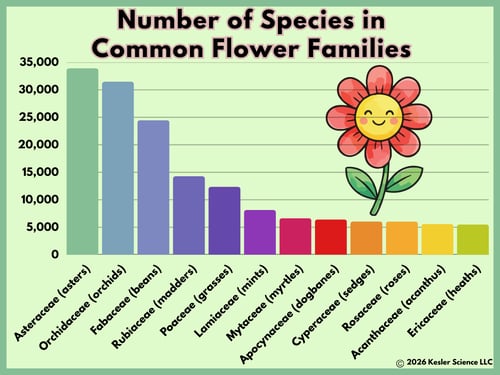
Here are some questions I think of when I look at this graph:
💡 What is the difference between the number of species between the two families with the most species?
💡 Can you tell which family has the largest population from this graph? Why?
💡 Why is Balanophoraceae not shown on this graph?

.png?width=352&name=Spookier%20Extinction%20Graph(4).png)