.png?width=375&height=100&name=WebPage%20logo%20with%20curves%202026%20(8).png)
The island of Hawai'i is truly a natural wonder. The lush landscapes, stunning beaches, and amazing weather make this state a paradise. It's in an unusual location as well. It's one of the most isolated populated places on Earth, sitting right in the middle of the massive Pacific Ocean. If you looked eastward from a beach in Hawai'i, there is a lot of water between you and the next major landmass - about 2,400 miles! (As a reference, the contiguous United States is 2,800 miles across. 😱)
The geology of Hawai'i and the Kilauea volcano are incredible too. It's one of the few places we consistently see active lava flows. But one of the most impressive features of this island might not be obvious at first glance.
On the northern end of the island of Hawai'i stands a mountain: Mauna Kea. It stretches about 4,206 meters (13,800 feet) above sea level, a respectable, but not record-breaking, height. Mountains in Alaska and Colorado are bigger. Depending on how geologists choose to measure it, though, some could consider Mauna Kea the tallest landform on Earth...even taller than Everest!
All of the Hawaiian Islands, including Mauna Kea, were formed by volcanic activity at the bottom of the Pacific Ocean. They grew from the bottom of the ocean. If measured all the way from the underwater base to the peak, Mauna Kea is more like 9,327 meters (30,600 feet) compared to Everest's 8,849 meters (29,032 feet.) The science gets a little murky when we compare mountains by pretending to drain oceans, though. Does Everest take a penalty because it rests on a continental plate? Where does Mount Everest technically "start"?
What if we compare Earth's mountains to the features of other planets? Earth doesn't have a monopoly on tall landforms. If we make the leap to space, there are some absurdly tall mountains within our solar system. The famous Olympus Mons mountain on Mars is 21,946 meters (72,000 feet) tall. The next time you see a commercial plane fly by, keep in mind that it's probably about 12,192 meters (40,000 feet) in the air. Now picture a mountain about twice that height. ✈️
There are huge mountains on non-planet objects as well. On the asteroid Vesta, which circles the Sun in the asteroid belt between Mars and Jupiter, there is a gigantic impact crater. In the center of this crater is a peak that measures roughly 21,366 meters (70,000 feet) from its base!
Here is a graph showing the locations of the solar system's tallest peaks. Earth's mountains are dwarfed by some of these giants!
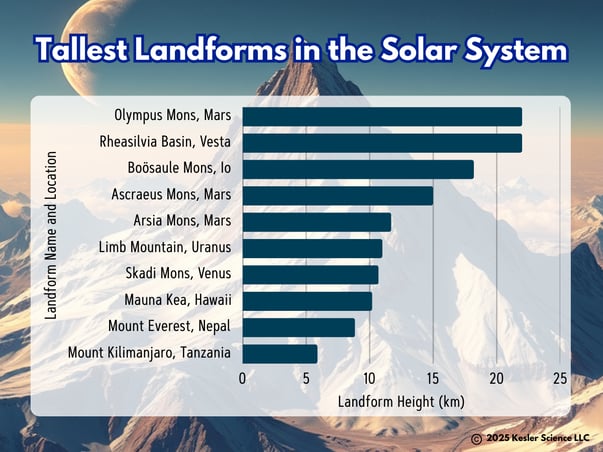
If I brought this graph into the classroom, here are some questions I'd have to go with it:
💡Which planet or moon has more than one landform listed among the tallest in the solar system?
💡What is the difference in height between the tallest landform on Earth and the tallest landform listed on Mars?
💡What pattern do you notice about the data on this table when comparing the heights of landforms on other planets or moons to those on Earth?
.png?width=352&name=Spookier%20Extinction%20Graph(7).png)