.png?width=375&height=100&name=WebPage%20logo%20with%20curves%202026%20(8).png)
I’ve watched a lot of pirate movies, so that naturally makes me an expert on sailing. Just kidding! But I did recently learn what I thought I knew about sailing was very wrong.
Antique ships used square sails. With those sails, wind blowing from behind the ship pushes into the sails, which pushes the ship forward. It’s simple, but there’s a problem. It only works about half the time. Square sails don’t work if you want to travel against the wind. Old ships had to follow the wind or break out the oars!
I thought that modern sailboats worked the same way – wind blows forward, ship moves forward. It turns out, modern sailboats have a lot more going on. In fact, the physics of sailing today has a lot in common with flying airplanes!
The wing of an airplane has two sides: the top and bottom.Both sides are curved, but the bottom is flatter than the top. This shape is called an airfoil.
When the plane starts moving forward, the airfoil makes air crossing the top move faster than air moving across the bottom. Air that is moving fast creates lower air pressure. The air underneath the wing is pushing up on the wing, and the air above does not have enough pressure to push down with the same force. This unbalanced force is strong enough to lift the plane off the ground!
Today’s triangular sails use the same principle to create“lift” that pulls the boat across the water. A sailboat can have the wind directly at its back, but the wind can also blow from the side!
How? When a sail billows outward, it creates an airfoil shape. Air coming from the side travels across the curve on the front, lowering the air pressure in the front. The wind that blows across the back of the sail moves more slowly. The low pressure in front of the sail creates "lift"that pulls the sailboat forward. The diagram below shows all the directions wind can blow and still create lift for a modern racing sailboat - only the red zone is a problem!
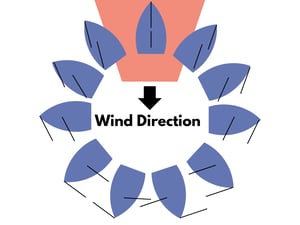 There is more to modern sailing than just sails, though. To give the ship more control, sailboats have a ridge, called the keel, that runs along the bottom of the ship. If the wind is trying to blow the ship at an angle, the force of the water on the keel works against the force of the wind. The captain adjusts the sail to keep the keel and the wind perfectly balanced, and the ship moves forward in a smooth line.
Can a modern ship move directly into the wind? Almost, but not quite! Instead, the sailboat ”tacks,” or zig-zags back and forth to catch the wind at an angle. First the ship travels slightly to the right of the direction of the wind, then it travels slightly to the left, then back to the right, and so on. The zig-zagging is slow, but it keeps the wind moving across the sails to create lift.
Wind and keel aren't the only two factors that affect the motion of a sailboat. Weight, sail shape, and boat length make a big difference, too. Racing teams, in particular, are very aware of the factors that affect speed and handling. Here's a histogram showing the length of all the sailboats inspected by the Offshore Racing Congress:
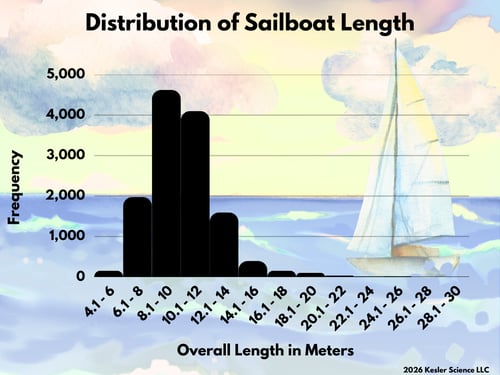
Here are some questions you can think about with this graph:
💡This graph is a histogram. Each label on the x-axis is a "bin." Every boat that is measured is sorted into the matching bin. Which bin would a boat 5.5 meters in length be sorted into?
💡Which bin represents the most common boat length? About how many boats are in that bin?
💡Imagine you are designing a marina with room for 100 boat slips (parking places for boats). You can make some of the slips fit boats that are shorter than 12 meters and some of them fit boats longer than 12 meters. How could you use evidence from this graph to plan how many of each size you should make?

.png?width=352&name=Chicken%20graph%20for%20phenomenon%20blog(1).png)