Some days, when I'm watching my fluffy, silly dog roll around on the floor, I'm amazed that dogs started off as close relatives of today's wolves. My dog is pretty smart, but she'd never survive in a forest (unless that forest was hiding a dog food factory). Humans have influenced dog traits for millennia, creating hundreds of breeds for different dog jobs. As a result, today's dogs are very different from where they started.
And then there are cats. Cats didn't start hanging around human settlements until we started growing and storing grain, which attracted rodents. Cats are amazing at hunting rodents, which was incredibly useful to humans. They were so perfect for that one job that we didn't try to create different breeds for any other jobs. We only started to make different breeds in the last 200 years, and those are only based on minor differences in how they look.
In fact, modern cats are so similar to their ancestors that some scientists say they are only "semi-domesticated." Wild cats survive so well without human help that there is almost always a population of wild cats near humans. House cats and these wild shorthair cats mix back and forth in every generation, which keeps cat DNA and habits closer to the original.
Why are cats such amazing hunters? You've probably seen videos of cats running along fence tops or twisting to land gracefully on their feet when they fall. Even today's modern cats have excellent balance, agility and flexibility. (But not enough that you should ever make a cat fall on purpose. Cats can break just like we do if they fall too far or don't have enough time to get their feet under them.)
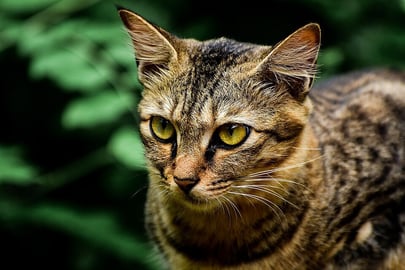
Did you know that cat collarbones are “floating," or unattached? This helps cats squeeze into tight spaces. They also have a flexible spine that helps them rotate different parts of their body at once, which helps them stick the landings when they fall.
Cat tails are also important for stability. 🐈 They have more vertebrae than we do, and the spinal column can compress like a spring for jumping energy. Their long tails are like the poles held by tightrope walkers; by shifting their tail from side to side, they balance the rest of their body.
Cats have soft paw pads and retractable claws, so their footsteps are muffled until it's time to attack. Cat eyes are fine tuned to pick up very dim light due to a reflective layer behind the retina called the tapetum lucidum. This creates that eerie eye shine at night! Super sensitive whiskers, hearing, and an instinct to stalk and pounce add to the cat's arsenal of hunting tools.
The downside? Cats are a little too good at hunting. With all the habitat destruction and other changes affecting small wild species, cats add another layer of pressure. It's enough of a worry that scientists have been researching how to reduce a cat's instinct to hunt. They've tried a variety of options, like feeding them more meat, giving them puzzles to solve in order to reach their food, playing more during the day, or wearing a colorful collar that birds can see clearly.
In the study below, the rate of prey means how often the cat owners see their pets catch birds or mammals in a month. The cats were measured for two months. One group was the control group and had no changes to their routines for the full two months of the experiment. The other groups were measured for one month, then they either had changes to their food or activities for a second month. Rates that have a range crossing below 1 mean the rate decreased in the second month. Check out the graph below:
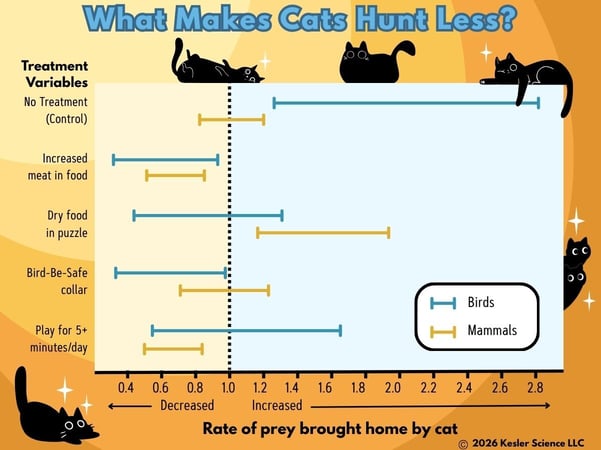
Here are some questions I think of when I look at this graph:
💡Which treatment variable shows the largest range in "rate of prey brought home by cat" for birds? What is that range?
💡Does the data suggest that domestic cats hunt because they are hungry or for another reason? Use information from the graph to justify your answer.
💡Write a short dialogue between a cat owner who used the "bird-be-safe collar" for the second month talking to an owner whose cat was in the control group. How would their experiences be different, and how would they be the same?
Graph source: https://www.sciencedirect.com/science/article/pii/S0960982220318960