.png?width=375&height=100&name=WebPage%20logo%20with%20curves%202026%20(8).png)
If I had a really expensive tool, do you know what I would NOT do with it? I would not drill a massive hole, drop it in, and leave it there. But that's exactly what a team of scientists did.
First, they traveled to Antarctica. Then they use a jet of water to drill an 8,000-foot-deep hole into the ice over the South Pole. They lowered their expensive piece of equipment into it, then let the hole freeze over again! 🧊 What were they trying to accomplish?
The equipment they installed in the ice of Antarctica is called a seismometer. There are seismometers located all over the globe. These sensitive devices detect movement within Earth's crust, mostly due to volcanoes or earthquakes. The Global Seismograph Network (GSN) is a fleet of 150 seismometers that link their data to create a very detailed live picture of geological activity all over our planet.
What does the GSN accomplish? A big part of its job is saving lives by predicting how waves from an earthquake may cause tsunamis. 🌊
There is a problem that seismographs have to work against, though. Earth is a constantly shifting planet. You might not notice, but the gravity of the Moon and the Sun pulls on our planet's crust, causing a shift of about a centimeter a day. Earth's rotation creates stress on the planet's crust, too. It's easy to forget that our planet spins 1,040 miles per hour at the equator! The seismograph network picks up all of the resulting ground movement as "noise," making it hard to tune into earthquakes. 🌎
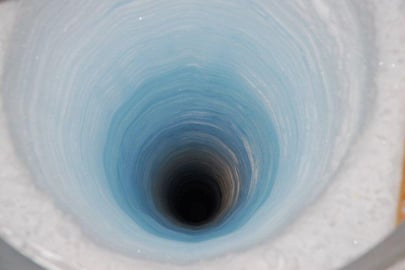
That's why the South Pole is a prime location for seismic detectors. The South Pole is as far away from the equator as you can get. It is near the point where the Earth rotates around. That means it experiences far less rotational seismic noise than most other locations on the planet. Scientists can isolate faint ground vibrations much more easily there. In fact, the name of the research site where scientists installed the seismometer is the "Quiet South Pole" station.
There is another benefit to having ground-detecting devices at the South Pole. The sensitive equipment can monitor other events that shake the ground around Antarctica. This includes man-made explosions, ocean waves, and big changes in glaciers and sea ice. The buried seismometer helps scientists pinpoint when and where huge pieces of ice crack, shift, or break away from glaciers. Antarctica holds 61% of Earth's fresh water in its ice, so scientists are excited about anything that helps them track changes there.
For example, the data for the graph below came from seismic stations in Alaska and Canada. The graph compares sea ice concentration and significant wave height in the Arctic.
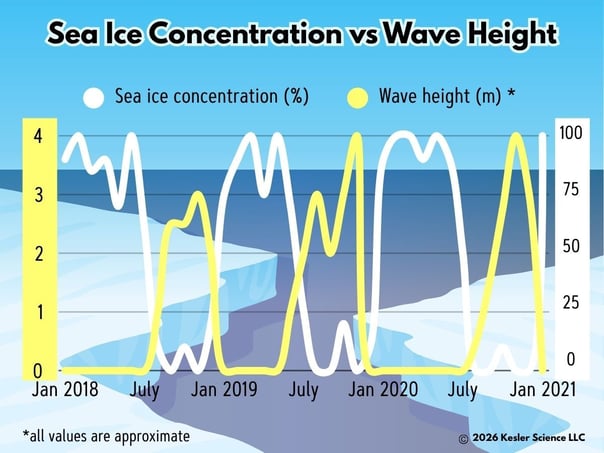
Here are some questions I think of when I look at this graph:
💡During what time of the year is sea ice concentration at its highest? During what time of year is the sea ice concentration at its lowest?
💡What relationship do you see between sea ice concentration and significant wave height? Use data from the graph to justify your answer.
💡The data shown in the graph was collected in the Northern Hemisphere. How do you predict sea ice data might look different if it were collected from Antarctica instead? Why do you say so?