Have you watched a swimming competition lately? Some of the swimmers may have been wearing high-tech suits that were inspired by shark teeth! Using ideas from nature to solve human problems is called biomimicry. Kingfisher birds have inspired bullet trains and gecko feet have led to new adhesives.
And then there's "necrobotics," where organisms don't just inspire new technology... they're used for parts!
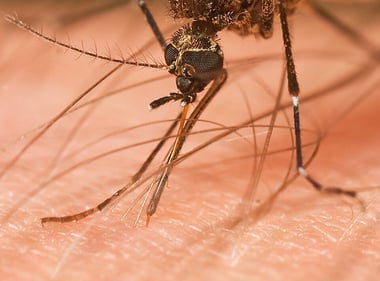
Take the world of 3-D printing, for example. If scientists could make the printers small enough, they might be able to deliver medicines directly to cells. The problem is the ink nozzles. Tiny metal nozzles break easily and get clogged as ink passes through. That's where mosquitos come into play! 🦟
Researchers have built 3-D printers that use a mosquito proboscis as the nozzle. This amazing combination was able to print designs with a thickness of 20 micrometers. That's half the width of a human hair! No metal nozzle can print that small of a design.
Another fascinating example: drones that follow can follow scents through the air. The goal is to make drones for search and rescue missions and finding hazardous materials, but scents are complicated chemicals. Instead of making an artificial system, researchers tried hawkmoth antenna. 🦋 These tough little structures pick up a huge range of scents to help the moth respond to its environment. When researchers attached antennae to their drones, the sensory cells detected chemical signals and produced electrical responses that the drones could follow.
Then there's the creepiest necrobot: the wolf spider. 🕷️ When spiders die, their legs automatically curl up in the classic "dead spider" pose. Why? Scientists discover that spiders don't use muscles to move their legs like people do. Spiders have a "hydraulic pump" system that pushes fluid into their legs to extend them. When they die, the pump stops working, so their legs contract.
Scientists tried pumping fluid back into a dead spider's hydraulic pump system, and the legs moved! By changing the pressure of the fluid, they could make the legs open and close like a claw game at an arcade. They think that this delicate "spider gripper" could help them carefully collect other insects without harming them.
Why are scientists excited about necrobots? Not only are these insect parts able to do amazing things, they have other advantages over normal technology. Insects are a renewable resource, so we can save non-renewable resources for other purposes. They're also cheap, and the cost savings can help small companies develop new technology without a big budget.
Not all insect parts are built the same, of course, and some have major drawbacks. Wolf spider exoskeletons dry out and crumble in a few days if the researchers don't coat them with beeswax. Some of the parts have to be replaced frequently. The graphs below show some of the strengths and weaknesses.
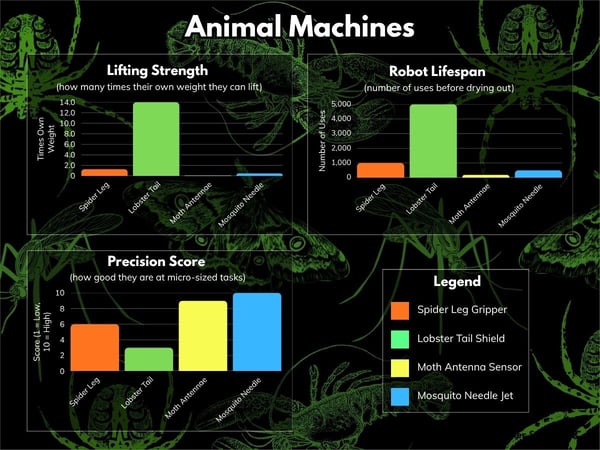
When I look at this graph, here are some questions I think of:
💡 If a scientist is building a machine that uses lobster tails, and the machine needs to perform its task 22,000 times, how many lobster tails would the scientist need to keep the machine working?
💡 Both the lobster tail and the spider leg gripper can be used to lift objects. What kind of situation might make a scientist choose the spider leg gripper instead of the much stronger lobster tail?
💡 The hawkmoth antenna never scores as high as the mosquito proboscis on the three measurements. Does that mean the proboscis is always a better choice than the antenna for any task? Explain your thinking.