If I asked you to hand me a sharp tool that could slice wood, what would you reach for? I'm thinking you'd probably reach for an axe or something usually hanging by a carpenter's bench. But what if I meant a pencil sharpener? Do you ever think of your school supplies, like paper clip and staples, as being tools?
A tool is anything that extends our ability to achieve a goal. It could be something as simple as a stick that lets you knock the highest fruit down from an apple tree, or it could be something as complicated as my laptop.
Over the years, we've found all sorts of creatures that use tools. In 1960, Jane Goodall was the first to see a chimpanzee to use a tool. The chimp pulled the leaves off twigs to make a stick. Then it would dip the stick into a termite mound and pull out an insect snack!
We've seen sea otters store their favorite stone in a fur pocket so it's always handy for cracking mussel shells. Asian elephants use grass to clean their ears. Honey badgers will make balls of mud and pile them into ramps to climb higher.
And it's not just mammals! Birds all over the world use tools to dig out insects, crack nuts, and even go fishing. Even invertebrates get in on the deal. The coconut octopus lugs around an empty coconut shell, so it always has a place to hide as it travels. 🥥🐙
Some creatures are "opportunistic" when it comes to tools; they use whatever is available without changing it much. Humans, on the other hand, don't just use tools. We make them, and sometimes we make tools that help us make other tools! We are, by far, the best in the tool game.
When you look at tool use across all of human history, you'll notice some patterns. Nearly every culture has some kind of tool for hunting and another for cutting meat. They'll have tools for digging and planting, and tools to help lift and carry.
Beyond those similarities, though, tools can look very different in different cultures. Swords can be straight or curved. Eating utensils might look like forks or they might look like chopsticks. Even the same kind of tool, like an axe, might come with different blades and handles.
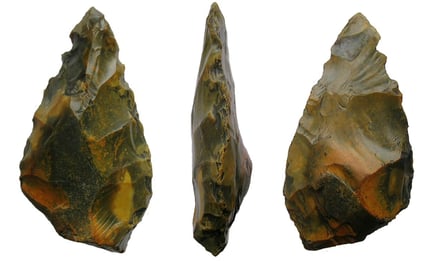
One kind of tool researchers have been digging up all over England is the handaxe. These are rocks that have been shaped to have a sharp edge for a blade, but they aren't attached to a stick or handle. People held the rounded back edge in their hands to cut meat, chop bone, or dig into the ground.
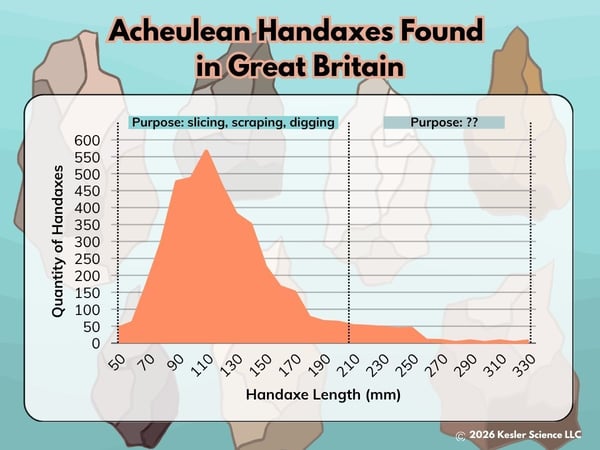
What is strange to the researchers is the size of some of the axes. Some fit normally into the average hand, but others are "giant" and would need two hands, at least, to use. Scientists are still looking for their purpose!
This graph shows the various sizes of stone handaxes found across Great Britain:
Here are some questions I think of when I look at this graph:
💡What is the size of the smallest handaxe in the collection? What is the size of the largest handaxe in the collection? What is the difference between these handaxe sizes?
💡The average length of a person’s palm is 100-110 mm. How does that measurement help explain patterns shown on the graph?
💡Scientists are still trying to determine why the original users would want a two-handed (or two-person!) handaxe. Some suggest that they might have been used for special purposes, rather than everyday purposes. Does the data in this graph support this claim?