Let's say you were a scientist, and you wanted to create a super sweet apple. You could create it the slow, patient way... or you could try the radioactive way.
The slow way is artificial selection, where you carefully cross-pollinate between different plants to strengthen traits you want. If you wanted a sweeter apple, you would find the trees that produced the sweetest apple, and you would pollinate between them. Those seeds would grow up into trees that made slightly sweeter apples, and you would pollinate those with other sweet apple trees. Slowly, over many generations, you would get a really tasty apple.
Or, you could zap the apple seeds with radiation and see if any useful mutations developed in the trees when they grew!
For example, grapefruits didn't always look the way they do today. Farmers at one time wanted sweeter, redder varieties than what grew naturally.
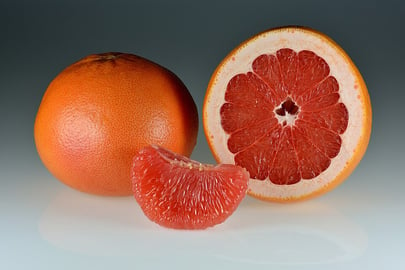
Scientists tried a method called the "gamma garden." Grapefruit plants were planted in a circle. In the center was a radiation source (the isotope cobalt-60) built into a special container that could be raised and lowered remotely. Scientists would raise the container to create gamma ray exposure. The radiation affected the plant DNA, causing mutations.
Were all of the mutations useful? No! Could the scientists be sure that they would get a mutation that created sweeter fruit? No! Many of the experimental fruits were unsuccessful and died because the mutations were too drastic. Some of the plant types grew tumors and abnormalities that buyers wouldn't want. Over time, a few changes emerged that growers actually wanted: cold resistance, seedlessness, and a bright red, sweet fruit. Those were the keepers. 👍
Atomic gardening is not the only strange way growers have changed plant DNA. Scientists have used X-rays and high energy beams of electrons and ions to alter the genes of different types of plants.
Want to hear a technique that's truly "out there"? Scientists have been sending plant seeds into space for the last 40 years! 🚀 The hope was that cosmic radiation, like the kind astronauts need to be careful of, would also cause genetic mutations in the plants. They were right; 66 viable (able to survive) plant mutations have resulted from trips to space. 🌌 A few years ago, a special flower exhibit was held to showcase the "Outer Space Sun." The star of the show was a beautiful bright pink lotus flower with seeds that were altered through space exposure.
You might be wondering if the gamma radiation makes our food radioactive. The answer is a big NO. The seeds are exposed to radiation, but the plants that grow from those seeds do not carry any radiation, and the fruits are completely safe.
Take a look at the graph showing the number of crop varieties that have been mutated through radiation:
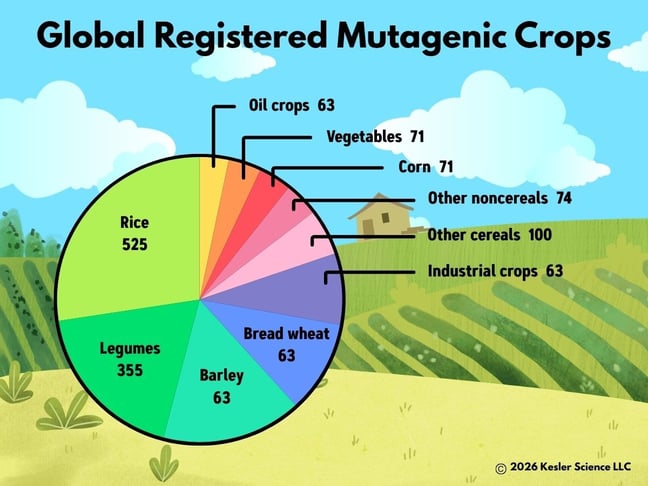
Here are some questions I think of when I look at this graph:
💡Cereal crops include wheat, rice, oats, corn, barley, and other cereals like rye, sorghum, and millet. They are used to feed people and livestock. What is the ratio of mutagenic varieties of cereal crops to all other crops?
💡Farms around the world produce about 1.2 billion metric tonnes of corn, 0.8 billion metric tonnes of wheat, and about 0.8 billion metric tonnes of rice. Do the pattern of these quantities correlate to the number of mutagenic varieties of those crops?
💡Does the data support this statement? "There are more mutagenic varieties of food crops than oil and industrial crops because food is more important than manufacturing."